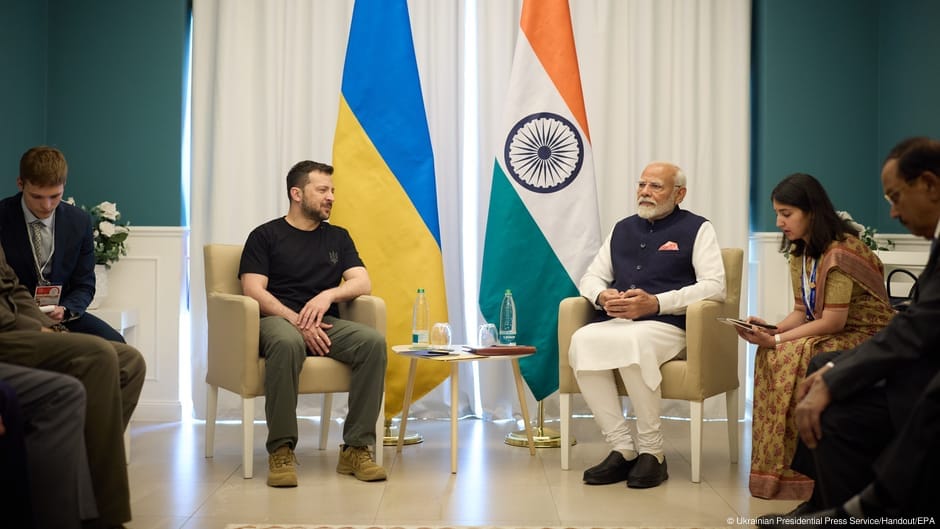
When Ukraine's President Volodymyr Zelenskyy announced after his Monday phone call with Indian Prime Minister Narendra Modi that 'India is ready to mediate in establishing corridors for grain exports in the Black Sea, blocked by Russian attacks,' it sounded promising on the surface. Yet the striking silence from Modi's office and India's foreign ministry tells a more revealing story. Neither the Prime Minister nor India's official statements mentioned the proposed food corridors at all. Modi only reiterated New Delhi's vague commitment to contributing 'in every possible way towards a peaceful resolution.' This glaring omission suggests India's mediation offer may be more rhetorical than substantive.
India's diplomatic positioning on Ukraine has long been built on ambiguity—claiming to champion dialogue and diplomacy while maintaining its 'close economic relationship with decades-long partner Russia since the start of the war in 2022.' Foreign Minister S Jaishankar's September visit to Kyiv and offer to help end the war seemed to signal deeper engagement, with Ukrainian Foreign Minister Andrii Sybiha later describing India's proposal as 'the most comprehensive' among four international truce proposals received. Yet months have passed, and the war continues. Jaishankar's October statement that India had 'got a little bit more involved beyond advocacy,' mentioning work on 'Black Sea safety of shipping' and grain exports, appeared to promise action. The current mediation offer suggests India is still trading in the currency of words rather than meaningful intervention.
What makes India's credibility particularly questionable is the context in which this offer emerges. Zelenskyy mentioned that Modi 'has said more than once, including directly to the Russian leader, that now is the time to end the war, not to continue it.' If Modi has already communicated this message directly to Russia's leadership, why would separate mediation on food corridors—a subsidiary issue compared to the broader conflict—require a fresh announcement? The timing, coinciding with trilateral talks between Ukraine, Russia, and the United States resuming Tuesday in Abu Dhabi, suggests India may be seeking visibility and influence in a process where it holds limited sway.
India's real constraint is structural, not tactical. New Delhi cannot simultaneously maintain its economic partnership with Russia, refrain from condemning Russian actions, and credibly mediate between Moscow and Kyiv. As long as India prioritizes its relationship with Russia over taking a principled stand on the invasion, its offers to mediate—whether on food corridors or broader peace—will lack the authority needed to move either party. Zelenskyy may welcome India's involvement out of desperation for any diplomatic opening, but Modi's silence on the specifics suggests even India recognizes the limitations of its position.
India should either commit genuinely to mediation, which requires distancing itself from Russia's actions, or acknowledge its constraints honestly. Half-measures that generate headlines while avoiding substantive commitment serve neither Ukraine's interests nor India's credibility in global diplomacy. The world needs mediators willing to risk relationships for principles. Until India demonstrates it can do that, its offers of mediation will remain strategic theater rather than serious statecraft.